
Did you ever get emotional about a textbook? Let’s rephrase that; did you ever experience positive, enjoyable emotions from a textbook? The kind that made you want to keep reading, keep learning, keep going?
Now think back to those old Choose Your Own Adventure books. Remember how the choices you made could result in one of two things? Being the hero of the story or complete catastrophe?
You were invested! You cared about the outcome. You probably read the same book multiple times just to explore different paths.
That’s the power of emotional engagement in learning. And it’s precisely what most online courses lack.
Here’s the uncomfortable truth about virtual learning environments: completion rates are dismal. Research consistently shows that online course completion rates hover between 5% and 15% for many platforms. Learners sign up with enthusiasm, engage for a week or two, then quietly disappear.
The content isn’t necessarily bad. The platforms work fine. So what’s missing?
Emotion. Investment. The feeling that this experience matters.
This is where Learning Experience Design (LXD) offers a fundamentally different approach. Rather than treating online learning as content delivery—uploading videos, PDFs, and quizzes into a system—LXD focuses on designing experiences that engage learners emotionally, keep them motivated, and guide them toward genuine skill development.
In this guide, we’ll explore what LXD actually is, why it matters for virtual learning environments, and how education providers can apply its principles to create courses learners don’t just start—but actually complete.
What Is Learning Experience Design (LXD)?
Learning Experience Design is a multidisciplinary approach that combines elements of instructional design, educational theory, user interface (UI) design, and user experience (UX) design. It’s underpinned by human-centred design, with a red-hot focus on the learner and the goals they want to achieve.
But here’s what sets LXD apart from traditional instructional design: it treats learning as an experience to be designed, not just information to be transmitted.
Traditional instructional design often follows systematic models like ADDIE (Analysis, Design, Development, Implementation, Evaluation). These frameworks are valuable, but they can become checkbox exercises—focused on content coverage rather than learner engagement.
LXD flips this. It asks: What does the learner need to feel, do, and understand? How can we design an experience that gets them there?
In itself, LXD is a design discipline using design principles, skills, and methods. It is not a step-by-step systematic exercise, but creative, experimental, and iterative, involving prototyping and user testing. Think of it like product design or UX design—but for learning.
The term “Learning Experience Design” was coined by Niels Floor in 2007, emerging from the recognition that learning professionals could benefit from applying design thinking methodologies to education. Since then, it has grown into a recognised field with its own community, conferences, and body of practice.
The principles of teaching adults have long emphasised that adult learners need relevance, autonomy, and practical application. LXD builds on these foundations while adding the creative, iterative design process that makes learning genuinely engaging.
What Is a Virtual Learning Environment (VLE)?
A virtual learning environment (VLE) is a digital platform designed to support teaching and learning. Common examples include Moodle, Blackboard, Canvas, and Google Classroom. In Australia, many RTOs and education providers rely on learning management systems to deliver accredited training, manage enrolments, and track learner progress.
VLEs typically offer features like:
- Content hosting (videos, documents, presentations)
- Assessment tools (quizzes, assignments, rubrics)
- Communication features (forums, messaging, announcements)
- Progress tracking and reporting
- Integration with other systems
The promise of VLEs is significant: accessible learning anytime, anywhere. Learners can study at their own pace, revisit materials as needed, and complete training without the logistical challenges of face-to-face delivery.
But here’s the gap: VLEs are excellent at content delivery and administration. They’re not inherently good at creating engaging learning experiences.
A VLE is a container. What you put inside it, and how you design the learner’s journey through it, determines whether learners engage deeply or click through passively.
This is why understanding LXD matters for anyone building courses within virtual learning environments. The platform provides the infrastructure. LXD provides the design thinking that transforms that infrastructure into something learners actually want to complete.
When evaluating the best eLearning platforms for your organisation, features matter. But the design of the learning experience within that platform matters more.
Why Emotion Matters in Learning
Everything we learn comes from an experience. We feel emotions during an experience, and emotions make the experience more memorable—in one way or another.
This isn’t just intuition. It’s neuroscience.
The amygdala, the brain’s emotional processing centre, works closely with the hippocampus, which is responsible for forming new memories. When we experience emotion—whether excitement, curiosity, surprise, or even mild anxiety—our brains flag that experience as important. It gets encoded more deeply. It sticks.
This is why you remember where you were during significant life events but forget what you had for lunch last Tuesday. Emotion acts as a highlighter for memory.
In learning contexts, this has profound implications. Content delivered without emotional engagement gets processed as background noise. Content delivered within an emotionally engaging experience gets remembered, applied, and built upon.
The existence of emotion in the learner’s journey is what sets Learning Experience Design apart from traditional teaching and learning methods. It is the power of this emotion, and the resultant learner investment and motivation that it provokes, that makes LXD so effective.
Consider the difference between formative and summative assessment. Formative assessment—ongoing feedback during the learning process—creates emotional touchpoints. Learners feel the satisfaction of progress or the productive discomfort of identifying gaps. Summative assessment alone (a final exam, a single quiz) misses these opportunities for emotional engagement throughout the journey.
Traditional VLE courses often fail here. They present content. They test recall. But they rarely create the emotional investment that drives genuine learning and completion.

Core LXD Principles for VLE Design
Applying LXD to virtual learning environments starts with understanding its core principles. These aren’t abstract theories—they’re practical guidelines for designing courses that work.
Learner-Centred Goals
LXD begins with the learner, not the content. What does the learner want to achieve? What problem are they trying to solve? What skill do they need to develop?
This sounds obvious, but many courses are designed around content that needs to be covered rather than outcomes learners need to reach. A training needs analysis conducted before design ensures you’re building something learners actually need.
Active Over Passive
Learning happens through doing, not just consuming. LXD prioritises activities, decisions, and practice over passive content consumption.
In a VLE context, this means moving beyond video-then-quiz structures. It means building in opportunities for learners to apply concepts, make choices, and see consequences.
Contextual Relevance
Adult learners especially need to see how content connects to their real-world context. Abstract theory without application feels pointless.
LXD emphasises situating learning within realistic scenarios, authentic problems, and recognisable contexts. When learners see themselves in the content, engagement increases.
Iteration and Testing
LXD is not a linear process. It involves prototyping, testing with real learners, gathering feedback, and refining.
This can feel uncomfortable for education providers used to “finishing” a course and moving on. But the best learning experiences are continuously improved based on data and learner feedback.
Accessibility and Inclusivity
Designing for diverse learners isn’t an afterthought in LXD—it’s built into the process. This includes considering different learning preferences, accessibility requirements, and cultural contexts.
LLN assessment (Language, Literacy, and Numeracy) is particularly relevant in the Australian VET sector, where learners may have varying foundation skill levels that affect how they engage with content.
How These Principles Translate to VLE Design
In practice, applying these principles means:
- Starting course design with learner interviews or personas
- Building interactive elements into every module
- Using realistic scenarios and case studies
- Piloting courses with small groups before full rollout
- Reviewing completion and engagement data regularly
- Ensuring content meets accessibility standards
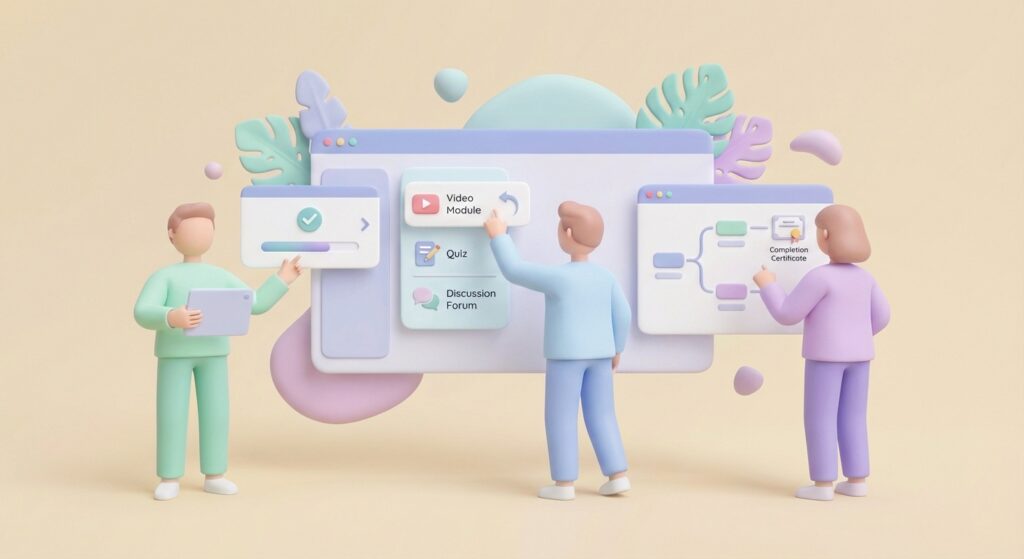
LXD Elements That Drive Completion in VLEs
Beyond principles, LXD offers specific elements and techniques that directly impact learner engagement and completion rates. Here’s how to apply them within virtual learning environments.
Scenario-Based Learning
Remember the Choose Your Own Adventure comparison? Scenario-based learning captures that same energy. Learners are placed in realistic situations where they must make decisions, face consequences, and navigate complexity.
This approach encourages critical thinking and problem-solving skills, with learners placed in active, problem-based learning scenarios. It transforms passive content consumption into active engagement.
In a VLE, scenarios can be delivered through branching content, interactive videos, or dedicated simulation tools. The key is giving learners agency—their choices matter.
Gamification Psychology
Gamification isn’t about adding points and badges to boring content. It’s about understanding the psychology behind why games engage us and applying those principles thoughtfully.
This includes
- Choice and autonomy: Letting learners control their path
- Clear goals and progress: Showing learners where they’re headed and how far they’ve come
- Appropriate challenge: Not too easy, not too hard
- Immediate feedback: Letting learners know how they’re doing in real-time
- Consequence and stakes: Making decisions feel meaningful
LMS training platforms increasingly offer gamification features, but the design thinking behind how you use them matters more than the features themselves.
Real-Time Feedback
One of the biggest advantages of digital learning is the ability to provide immediate feedback. Yet many VLE courses still rely on delayed assessment—submit an assignment, wait days for a response.
LXD emphasises real-time feedback to keep learners oriented and motivated. This can include:
- Instant quiz feedback with explanations
- Progress indicators throughout modules
- Automated check-ins based on learner behaviour
- Peer feedback mechanisms
The goal is ensuring learners never feel lost or uncertain about how they’re progressing.
Adaptive Learning Paths
Data analytics can be used to create adaptive learning paths, providing personalised content that responds to the learner’s progress and performance.
Rather than forcing every learner through identical content in identical order, adaptive systems can:
- Skip content learners have already mastered
- Provide additional support where learners struggle
- Offer choice in how learners demonstrate competence
- Adjust difficulty based on performance
This personalisation respects learners’ time and meets them where they are.
Simulations and Interactive Elements
LXD emphasises interactive elements like simulations, gamified learning, and real-time feedback to keep learners engaged and motivated.
In VLEs, this might include:
- Virtual labs or practice environments
- Interactive diagrams and explorations
- Role-play simulations
- Collaborative problem-solving activities
The key is moving learners from watching to doing.
Microlearning and Chunking
Cognitive load theory tells us that working memory has limits. Dumping large amounts of content on learners overwhelms their capacity to process and retain information.
LXD applies chunking—breaking content into smaller, focused segments—and microlearning approaches that respect how attention and memory actually work.
In a VLE, this means shorter modules, clear learning objectives for each segment, and avoiding the temptation to cram everything into marathon sessions.
The Collaborative Nature of LXD
As in many design fields, LXD is collaborative. It can involve educators, graphic designers, UX and UI designers, cognitive psychologists, and coders—working together to create a deeply engaging learning experience.
This multidisciplinary approach matters because great learning experiences require diverse expertise:
- Subject matter experts bring content knowledge
- Instructional designers structure the learning journey
- UX designers ensure the experience is intuitive and accessible
- Graphic designers create visual engagement
- Developers build interactive functionality
- Data analysts measure what’s working
No single person holds all these skills. Collaboration isn’t optional—it’s essential.
Prototyping and User Testing
LXD borrows from product design the practice of prototyping and testing before full development. Rather than building a complete course and hoping it works, LXD practitioners:
- Create rough prototypes of key interactions
- Test with representative learners
- Gather feedback on what’s confusing, engaging, or frustrating
- Iterate before investing in polished production
This approach catches problems early and ensures the final product actually works for learners.
For Smaller Teams
Not every education provider has access to a full multidisciplinary team. But the collaborative mindset can still apply:
- Involve learners in the design process through interviews or focus groups
- Seek feedback from colleagues with different perspectives
- Use pilot groups to test before full rollout
- Partner with external specialists for specific elements
The principle is the same: don’t design in isolation.

Technology as Enabler: AI, Gamification, and Immersive Learning
This all sounds very tech-heavy because it is—leveraging technology is a key aspect of LXD today. But it was not always so. The principles of designing emotionally engaging learning experiences predate digital technology.
What’s changed is capability. In this age of burgeoning AI, we have the opportunity like never before to incorporate powerful approaches to gamification and augmented/virtual reality.
Current Opportunities
Artificial Intelligence is transforming what’s possible in learning design. AI can power:
- Adaptive learning systems that respond to individual learner behaviour
- Natural language processing for more sophisticated assessment
- Automated feedback and coaching
- Personalised content recommendations
Augmented and Virtual Reality create immersive experiences that were previously impossible. Learners can practice procedures, explore environments, and experience scenarios that would be impractical or dangerous in real life.
Sophisticated Gamification tools allow for complex branching narratives, meaningful choices, and rich feedback systems that rival entertainment gaming.
AI-Powered Roleplay: Solving the High-Stakes Conversation Problem
One area where technology is particularly transformative is training for high-stakes conversations. Healthcare consultations, difficult client interactions, crisis interventions—these skills have traditionally required human actors for realistic practice.
The problem? Human actors are expensive, difficult to schedule, and inconsistent. Many education providers simply skip realistic roleplay practice, leaving learners to figure it out on the job.
SethCo represents a new approach: AI-powered roleplay training where learners practice conversations with realistic AI characters. These aren’t scripted chatbots—they’re AI personas with psychological depth that respond naturally to what learners say.
This solves the cost, scheduling, and availability problems while providing something traditional VLEs can’t: genuine practice for interpersonal skills, available 24/7 with real-time feedback aligned to learning objectives.
It’s a practical example of LXD principles applied through technology—creating emotionally engaging, active learning experiences for skills that matter.
Balancing Technology and Learning Outcomes
The temptation with new technology is to use it because it’s impressive rather than because it serves learning. LXD keeps the focus on outcomes.
The question isn’t “How can we use AI?” but “What learning experience do we need to create, and can AI help us create it better?”
Technology is an enabler, not the point.
LXD as an Antidote to the AI Shortcut Problem
Speaking of AI—there’s a challenge facing education right now that makes LXD more relevant than ever.
Internationally, many education thought-leaders are reconsidering project-based learning as an antidote to students merely developing their skills in prompting and copy-pasting rather than actual educational content.
The concern is legitimate. When learners can generate essays, solve problems, and complete assignments using AI tools, what are they actually learning? If the goal is demonstrating knowledge through written output, AI has made that trivially easy to fake.
Why LXD Matters Here
LXD’s emphasis on active, problem-based learning offers a response. When learning experiences are designed around:
- Making decisions in realistic scenarios
- Demonstrating skills through performance (not just written output)
- Engaging with feedback and iteration
- Applying knowledge to novel situations
…they become much harder to shortcut through AI prompting.
You can’t copy-paste your way through a branching simulation. You can’t prompt your way through a roleplay conversation. You can’t fake engagement with real-time adaptive feedback.
Designing Experiences That Can’t Be Gamed
This doesn’t mean making learning adversarial or trying to catch cheaters. It means designing experiences where the learning happens in the doing—not in the final output.
When the experience itself is where learning occurs, the incentive to shortcut disappears. Why would you skip the valuable part?
This is the pedagogy in education that LXD enables: learning through experience, not just content consumption and regurgitation.
The Educator’s Role
As we continue to navigate the challenges and opportunities of technology in education, embracing LXD is not just beneficial—it’s essential.
The educator’s role shifts from content deliverer to experience designer. The question changes from “What do learners need to know?” to “What experiences will help learners develop genuine capability?”
This is more demanding. It requires creativity, iteration, and a willingness to experiment. But it’s also more rewarding—and more effective.
Practical Steps: Applying LXD to Your VLE Courses
Theory is valuable, but application is where it matters. Here’s how to start applying LXD principles to your virtual learning environment courses.
Audit Your Current Courses
Start by reviewing existing courses with fresh eyes. Ask:
- Where are learners dropping off? (Check your analytics)
- Which modules have the lowest engagement?
- Where is content purely passive (video, reading, no interaction)?
- What emotions might learners experience at each stage?
- Do learners have agency, or are they on rails?
This audit identifies opportunities for improvement.
Identify Passive Content That Could Become Interactive
Look for content that’s currently delivered passively but could become active:
- A video explaining a process → A simulation where learners perform the process
- A reading about decision-making → A branching scenario where learners make decisions
- A quiz testing recall → A case study requiring application
- A list of best practices → A troubleshooting exercise
Not everything needs to be interactive. But the balance should shift toward active engagement.
Map Learner Goals Before Designing Content
Before creating new content, conduct a training needs analysis that centres on learner goals:
- What do learners want to be able to do after this course?
- What problems are they trying to solve?
- What contexts will they apply this learning in?
- What do they already know?
Design backward from these goals, not forward from content you want to cover.
Build in Feedback Loops and Checkpoints
Ensure learners receive regular feedback throughout their journey:
- Progress indicators showing completion
- Formative assessments with immediate feedback
- Reflection prompts asking learners to self-assess
- Opportunities to revisit and retry
Feedback keeps learners oriented and motivated.
Start Small: One Module, Test, Iterate
You don’t need to redesign everything at once. Pick one module—ideally one with low completion or engagement—and apply LXD principles:
- Add interactive elements
- Create a scenario or decision point
- Build in feedback
- Test with a small group
- Gather feedback and refine
Learn from this pilot before scaling.
Conclusion: Why LXD Is Essential Now
Everything we learn comes from an experience. The question is whether that experience is designed intentionally—or left to chance.
Virtual learning environments offer unprecedented access to education. Learners can study anything, anywhere, anytime. But access without engagement is hollow. A course that sits uncompleted in someone’s dashboard hasn’t taught them anything.
Learning Experience Design offers a different path. By centring emotion, prioritising active engagement, and designing iteratively with learners in mind, LXD transforms VLE courses from content repositories into genuine learning experiences.
The elements are clear:
- Scenario-based learning that creates investment
- Gamification psychology that motivates progress
- Real-time feedback that keeps learners oriented
- Adaptive paths that personalise the journey
- Technology that enables what wasn’t possible before
The opportunity for education providers is significant. Those who embrace LXD principles will create courses learners actually complete—and more importantly, courses that develop genuine capability.
The cost of continuing with disengaging content is equally clear: low completion rates, poor outcomes, and learners who associate online learning with boredom rather than growth.
As we continue to navigate the challenges and opportunities of technology in education, embracing LXD is not just beneficial—it’s essential.
As educators, it is a very technologically exciting time to be alive.
The tools are better than ever. The understanding of how learning works is deeper than ever. The opportunity to create experiences that genuinely transform learners is greater than ever.
The question is: will you design for it?
