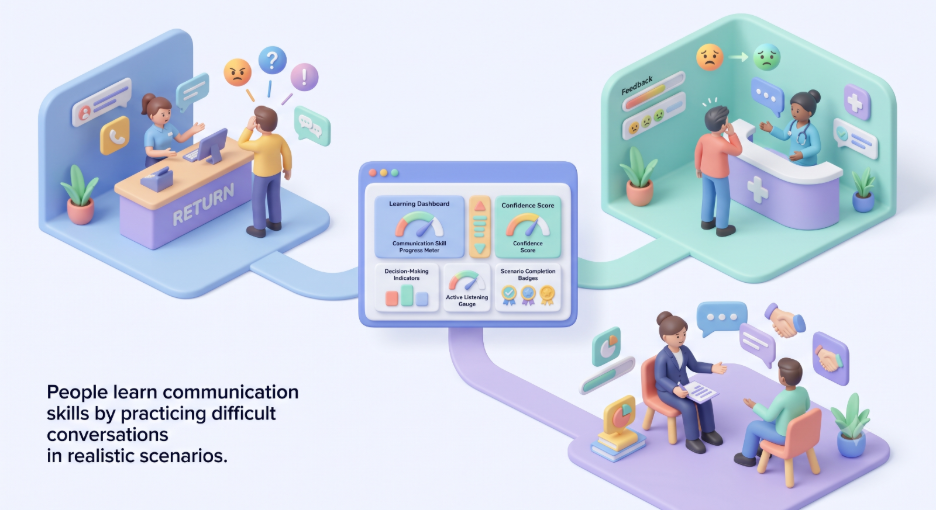
When we evaluate the core competencies required for frontline success, customer interaction skills consistently rank at the top. Whether an employee is managing a complex retail return, de-escalating a frustrated patient in a busy clinic, or negotiating a critical service contract, their ability to communicate effectively under pressure dictates the outcome. However, despite the universal recognition of their importance, these skills remain notoriously difficult to teach. As trainers and instructional designers, we know that human beings do not acquire complex communication abilities simply by reading about them. True skill acquisition demands action. It requires the student to make difficult decisions, respond to unpredictable social cues, and experience the immediate consequences of their words in a realistic environment.
Despite this fundamental understanding, a significant portion of vocational and corporate training still defaults to passive instruction. We routinely assign students hours of click-through video modules, operating on the flawed assumption that information delivery will somehow translate into sustained behaviour change. It rarely does. This article deeply explores the foundations of teaching communication through the lens of learning by doing. We will examine why active practice consistently outperforms passive methods, dissect the mechanics of deliberate practice, and explore how modern educators are solving the logistical challenge of delivering experiential learning at scale.
The Unique Challenge of Customer Interaction Skills
Technical skills often follow a predictable, linear path. In the apprentice trades, a carpentry student can learn to cut timber by following a strict sequence of physical steps. The timber does not magically change its properties halfway through the cut. Customer interaction skills, however, are fundamentally non-linear. Human behaviour is chaotic, highly emotional, and unpredictable. A customer service representative might start a conversation following a standard company script, only to have the client suddenly change their tone, introduce completely new complaints, or become entirely unresponsive.
Because of this inherent unpredictability, relying on memorised scripts or theoretical flowcharts is a highly fragile training strategy. A script can provide a useful baseline, but it cannot teach the emotional intelligence required to read a room. It cannot teach the subtle micro-adjustments in tone required to soothe an anxious aged care resident. These competencies require a deep understanding of human friction. They require the student to physically experience the stress of the interaction, process the emotional weight of the moment, and adapt their strategy on the fly. This level of adaptability cannot be cultivated in a passive learning environment; it must be forged through direct, repeated experience.
Learning by Doing: The Theoretical Foundation
While applying experiential methods to soft skills feels like a modern reaction to the limitations of digital e-learning, its roots stretch back over a century. Educational philosopher John Dewey argued that education is not merely preparation for future life, but a continuous process of living itself. He believed that students must actively interact with their physical and social environment to truly understand it, rejecting the outdated idea of the student as a passive recipient of facts.
Decades later, David Kolb formalised this concept into his widely adopted experiential learning cycle, proposing that effective learning occurs through a continuous four-stage process. First, the student must engage in a concrete experience; they must actually perform the task or have the difficult conversation. Next, they must engage in reflective observation, pausing to think critically about what just happened and why they achieved a specific outcome. Then, they move into abstract conceptualisation, forming new mental models or modifying their existing understanding based on those reflections. Finally, they engage in active experimentation, directly applying these newly formed ideas to future situations.
The critical insight from Dewey and Kolb is that the physical act of performing is only half the equation. The action must be intimately paired with structured reflection. Donald Schön later expanded heavily on this idea with his concept of the reflective practitioner. Schön emphasised that professionals learn best when they are taught to think critically about their actions while they are actively performing them. This continuous cycle of action, feedback, and reflection forms the absolute core of effective training practice for customer-facing roles.
Why Passive Instruction Fails Frontline Teams
If the theory of experiential learning is firmly established, why do passive methods remain so incredibly dominant? The answer is perceived efficiency. It is significantly cheaper to broadcast a generic video module on communication to a thousand employees than to provide a thousand opportunities for supervised practice. However, experienced educators know this efficiency is a dangerous illusion. When the primary goal is actual skill acquisition, passive methods consistently underperform.
A hospitality service worker cannot learn to manage a demanding, unhappy table simply by reading a training manual. The manual provides the correct sequence of service, but it cannot teach the physical sensation of staying calm while being yelled at, or the nuanced judgement required to offer the correct compensation. The VET classroom context relies heavily on practical demonstration for this exact reason.
Passive methods fail because they completely remove the cognitive load associated with real-world performance. When passively watching a video about conflict resolution, the student is not forced to make split-second decisions under pressure. They are not required to recall specific company policies while simultaneously managing a complex social interaction. Without the opportunity to perform the task in a realistic setting, the student builds incredibly fragile knowledge. This fragile knowledge typically shatters the moment they face the unscripted, chaotic reality of the workplace, leading to poor performance, severe anxiety, and high staff turnover rates.
Building Competence Through Deliberate Practice
Not all active practice is created equal. Throwing a novice student into a highly difficult, unstructured situation is not a valid strategy; it is a recipe for extreme anxiety. For experiential learning to be genuinely effective, the practice must be structured and intentional.
For example, a student nurse engaging in healthcare clinical practice does not repeatedly attempt to deliver difficult news to a patient in isolation. They perform the action under observation and receive immediate, personalised corrections from a senior clinician regarding their phrasing, body language, and bedside empathy. This tight feedback loop is exactly what turns mere mindless repetition into genuine, measurable improvement.
Furthermore, effective practice requires a low-stakes environment. Students must be allowed to make mistakes without facing severe operational or financial consequences. If the cost of failure during a training exercise is a lost client or a formal warning, students will naturally avoid taking risks. They will default to safe, familiar behaviours, completely stifling the experimentation necessary for the learning process. An environment that punishes errors during the learning phase fundamentally misunderstands how human beings acquire new competencies.
Situated Cognition and Contextual Relevance
The second critical element of effective active learning is contextual relevance. The practice environment must closely mirror the actual conditions of the job the student is preparing for. Situated cognition theory tells us that knowledge is intimately and permanently tied to the context in which it is learned. If we strip the context away during training, the student will inevitably struggle to transfer the skill to their actual workplace.
If a local government worker is training to handle an aggressive resident regarding planning permissions, the training scenario cannot take place in a quiet, sterile classroom. It must incorporate the environmental noise, the urgency, and the emotional weight of a real public counter. The student needs to experience the friction of the interaction to build the resilience required to handle it gracefully in reality.
This focus on contextual, active practice is the absolute cornerstone of effective vocational education. The goal is to develop workers equipped with practical job ready skills that employers immediately value. In Australia, the national training system is built entirely upon this philosophy. As detailed in various competency-based training frameworks, a student is only deemed competent when they can physically demonstrate their ability to perform a specific task to an industry standard. By embedding the learning within a highly authentic context, we ensure that the cognitive pathways developed during practice are easily accessed when the student faces the exact same triggers on the floor.

The Logistical Hurdles of Experiential Training
Delivering this level of practical, competency-based training presents immense logistical challenges for educators and registered training organisations. Providing sufficient opportunities for every single student to achieve mastery through repetition requires significant time, physical resources, and expert supervision.
This scaling problem becomes particularly acute when teaching soft skills. Technical skills can often be practised independently. A mechanic can practise assembling a gearbox on a workbench alone for hours. But a manager practising a difficult performance review conversation, or a retail worker practising de-escalation techniques, traditionally needs a live human partner.
Historically, this has meant pulling colleagues into awkward, artificial peer-to-peer roleplay exercises. As any experienced trainer knows, these exercises rarely achieve their intended goals. Colleagues go easy on each other, break character, and fail to provide the objective feedback required for true deliberate practice. Alternatively, organisations must take their most experienced managers off the floor to act as practice partners, essentially paying two people to do the job of one. As a result, organisations often reserve true experiential learning for high-risk, high-cost roles, while tragically leaving their frontline workers to learn by trial and error on the job.
Designing the Modern Practice Environment for Customer Interaction Skills
To solve this persistent scaling problem, training functions are increasingly looking to re-evaluate their entire approach to practice environments. This is not about simply purchasing new software; it is about fundamentally rethinking how we facilitate the Kolb learning cycle. Thoughtful learning experience design is crucial here. The overarching goal is to build intelligent, accessible environments where students can engage in the continuous cycle of action, feedback, and reflection without constantly requiring the presence of a live supervisor.
Educators must ask themselves how they can create spaces that offer the friction of reality without the consequences of failure. This involves mapping out the exact competencies required, identifying the specific scenarios where those competencies are tested, and designing safe mechanisms for students to repeatedly face those scenarios. Whether physical or digital, the modern practice environment must prioritise psychological safety, allowing students to stumble, ask questions, and try again without judgement. It is only in these psychologically safe spaces that true competence is born.
Technology as a Scalable Solution for Soft Skills
Increasingly, the most viable way to democratise access to this level of rigorous practice is through sophisticated technology. We are seeing a significant rise in the application of immersive learning methodologies across both corporate and vocational sectors. Virtual reality, for example, can place a civil construction apprentice on a highly realistic, simulated building site, allowing them to identify hazards and practise critical safety protocols in a perfectly controlled setting before ever stepping foot on a real site.
Similarly, for the complex realm of conversation-based skills, we are seeing the emergence of highly effective roleplay training powered by artificial intelligence. These platforms build customer interaction skills by allowing learners to speak directly with simulated clients, patients, or colleagues. These digital personas can be programmed to present difficult objections, express extreme frustration, or require nuanced de-escalation, providing the necessary conversational friction for genuine skill development.
These tools offer a highly scalable way to provide deliberate practice. A student can use simulation training for real world scenarios to repeat a difficult financial hardship conversation twenty times before they ever interact with a real, vulnerable customer, receiving objective, instantaneous feedback after every single attempt. This technology-enabled approach ensures that learning by doing is no longer artificially restricted by the limited availability of senior staff.
Conclusion
The principle of learning by doing remains the undisputed gold standard of education. When teaching complex customer interaction skills, the pedagogical truth remains the same: we learn best when we act, reflect, and try again. By embracing scalable methods of experiential practice, educators can build training programs that deliver measurable competence rather than fragile knowledge. The ultimate goal is to ensure every worker walks onto the floor with the practical, rehearsed confidence required to excel in the unpredictable reality of human interaction.