
Conversational AI is no longer just powering chatbots and virtual assistants, it’s reshaping how students learn and how institutions deliver support. From 24/7 tutoring assistance to scenario-based training simulations, conversational AI enables educational institutions to scale personalised learning, automate routine support, and create interactive experiences that were previously impossible to deliver consistently across large student populations.
However, implementing conversational AI in educational contexts presents unique challenges. Institutions require accuracy, safety, curriculum alignment, and controlled knowledge systems rather than open-ended AI that might generate inappropriate or incorrect responses. This guide explores what conversational AI is, how it works, its applications in education, implementation strategies, and how schools and training providers can deploy these systems responsibly and effectively.
What Is Conversational AI?
Conversational AI is a form of artificial intelligence that enables computers to engage in human-like dialogue through text or voice. It uses natural language processing (NLP), machine learning (ML), and speech recognition to understand, interpret, and respond to user input in real time, creating interactive conversational experiences that feel natural and contextually appropriate.
Unlike simple scripted chatbots that follow predetermined response trees, conversational AI systems understand intent, context, and nuance in user queries. They can handle variations in phrasing, maintain conversation context across multiple exchanges, and generate responses dynamically rather than selecting from fixed templates.
Core Technologies Behind Conversational AI
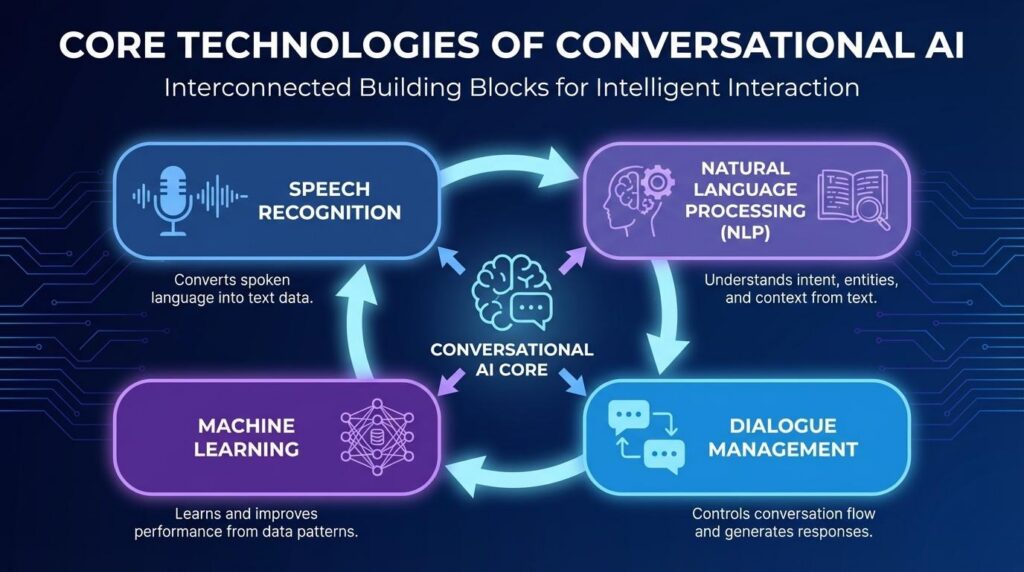
Several interconnected technologies power conversational AI systems:
Natural Language Processing (NLP) enables AI to understand human language structure, extract meaning from text or speech, identify intent behind queries, and interpret context. NLP breaks down sentences into components, analyses grammatical structure, and determines what users are actually asking even when phrased in different ways.
Machine Learning (ML) allows conversational AI to improve over time by learning from interactions, identifying patterns in user queries, refining response accuracy, and adapting to new conversation types. ML models are trained on vast conversation datasets to recognise intent patterns and generate appropriate responses.
Automatic Speech Recognition (ASR) converts spoken language into text for voice-based conversational AI applications. ASR systems process audio input, account for accents and speech patterns, filter background noise, and transcribe speech accurately for the NLP system to interpret.
Dialogue Management Systems maintain conversation flow, track context across exchanges, determine appropriate responses based on conversation history, and guide interactions toward productive outcomes. These systems ensure conversations feel coherent rather than disconnected question-answer pairs.
Together, these technologies create AI systems capable of understanding questions, maintaining context, generating relevant responses, and engaging users in natural, productive dialogue.
Conversational AI vs Generative AI: What’s the Difference?
While often confused, conversational AI and generative AI serve distinct purposes and operate differently:
| Feature | Conversational AI | Generative AI |
| Primary Focus | Dialogue and interaction | Content creation |
| Interaction Style | Structured, goal-oriented conversation | Open-ended generation |
| Knowledge Scope | Often domain-contained and specific | Typically broad knowledge base |
| Common Applications | Chatbots, virtual assistants, support agents | Text generation, image creation, code writing |
| Response Type | Contextual answers to queries | Original content creation |
| Control Level | Higher control over responses | Less predictable outputs |
In educational contexts, this distinction matters significantly. Conversational AI provides structured guidance through defined knowledge domains, answering course-specific questions, guiding students through learning material, or facilitating scenario-based practice. Generative AI creates open-ended content but may introduce inaccuracies, go beyond defined curriculum boundaries, or generate inappropriate material.
Educational institutions typically require the control and containment that conversational AI offers rather than the creative freedom of generative systems. This ensures responses align with curriculum, maintain accuracy, and stay within appropriate educational boundaries.
Common Use Cases of Conversational AI
Conversational AI has been widely adopted across industries for various applications that demonstrate its versatility and value.
Enterprise & Business Applications
Customer Support Chatbots handle routine inquiries, troubleshoot common issues, guide users through processes, and escalate complex problems to human agents. These systems reduce support costs while providing instant assistance.
Virtual Assistants schedule meetings, manage calendars, set reminders, retrieve information, and help employees navigate internal systems. Enterprise virtual assistants improve productivity by automating routine administrative tasks.
HR Screening and Onboarding systems conduct initial candidate interviews, answer employee questions about policies and benefits, guide new hires through onboarding processes, and provide information about company resources.
Appointment Scheduling Systems manage bookings, send reminders, handle rescheduling requests, and coordinate availability across multiple parties without human intervention.
Voice-Based Conversational AI
Smart speakers, voice assistants, and automotive systems utilise voice-based conversational AI to enable hands-free interaction. These systems respond to spoken queries, control connected devices, provide information verbally, and perform tasks through voice commands.
Voice-based conversational AI extends accessibility by enabling interaction without keyboards or screens, supporting users with visual impairments, and allowing multitasking during conversations.
While these enterprise and consumer applications demonstrate conversational AI’s capabilities, educational implementations require specialised approaches that address unique institutional needs, safety requirements, and learning objectives.
Conversational AI in Education: A Transformational Use Case

Educational institutions face persistent challenges that conversational AI addresses uniquely well: scaling personalised support, providing 24/7 assistance, automating routine queries, and creating interactive learning experiences across large student populations.
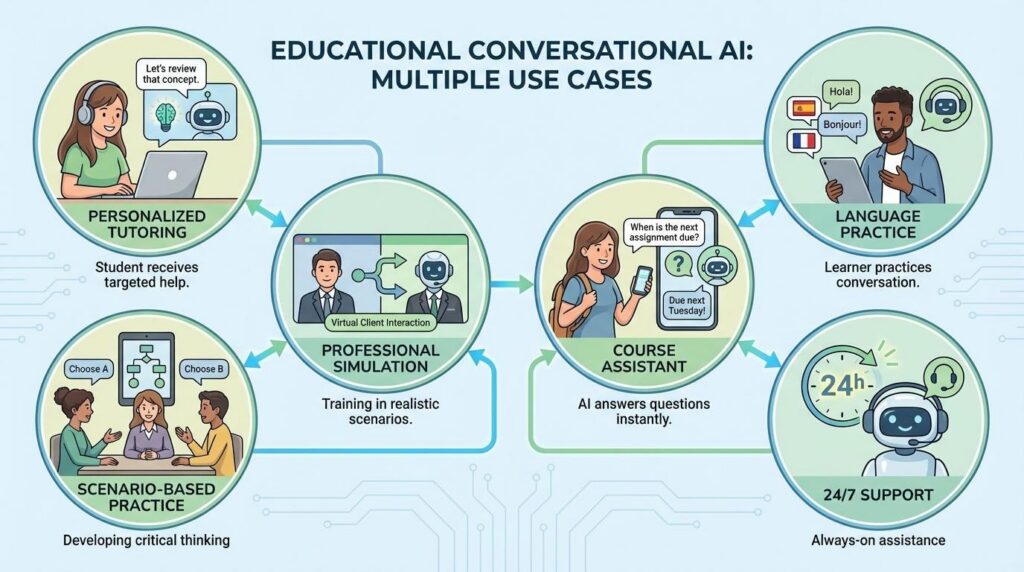
Student Tutoring Support through conversational AI provides on-demand help with course material, explains concepts using multiple approaches, answers questions at any hour, and adapts explanations to student understanding level. AI tutors supplement instructor availability, ensuring students receive support when they need it rather than waiting for office hours.
Course-Based AI Assistants answer questions about syllabus details, assignment requirements, deadline information, course policies, and procedural questions. This reduces repetitive faculty workload while ensuring students receive instant, accurate answers to common queries.
Scenario-Based Simulations enable students to practice communication skills, professional interactions, decision-making processes, and interpersonal dynamics through conversational scenarios. Students engage with AI personas representing customers, patients, colleagues, or other professional roles, gaining practice experience without real-world consequences.
Language Learning Applications provide conversation practice in target languages, offer immediate feedback on grammar and vocabulary usage, adapt to proficiency levels, and create low-pressure environments for experimentation. Conversational AI gives language learners unlimited practice opportunities with patient, always-available conversation partners.
Professional Training and Skill Development through AI-powered simulations allows trainees to rehearse difficult conversations, practice interview techniques, develop conflict resolution skills, and build professional communication competencies through structured, repeatable scenarios.
Role-Based Communication Practice prepares students for workplace interactions by simulating supervisor conversations, client meetings, team collaborations, and professional networking situations. This experiential practice builds confidence before encountering similar situations in actual professional contexts.
The educational value of conversational AI depends critically on institutional controls: curriculum alignment ensures responses support learning objectives, safe response boundaries prevent inappropriate content, contained knowledge systems reduce hallucinations and inaccuracies, and structured personas maintain educational focus rather than drifting into entertainment.
Benefits of Conversational AI for Schools and Training Providers
1. Improved Learning Accessibility
Conversational AI removes barriers to educational support through 24/7 availability that extends learning beyond classroom hours, multilingual interaction capabilities that support diverse student populations, and reduced hesitation factors where students ask AI questions they might feel embarrassed asking instructors.
Students access help when they need it, be it late night study sessions, weekend assignment work, or moments of confusion during self-paced learning, without waiting for instructor availability. This immediate access reduces frustration, maintains learning momentum and prevents small confusion from becoming significant knowledge gaps.
2. Personalised Learning at Scale
While human instructors provide invaluable personalised attention, they cannot deliver individualised support to hundreds or thousands of students simultaneously. Conversational AI enables adaptive feedback that responds to individual student queries, progress-sensitive responses that adjust explanation complexity based on student understanding level, and learning pathway customisation that guides students through material at appropriate paces.
AI systems remember previous student interactions, track areas of difficulty, identify patterns in questions, and adjust support strategies accordingly. This personalisation at scale supplements instructor efforts rather than replacing the human relationships central to education.
3. Operational Efficiency
Educational institutions dedicate substantial staff time to repetitive questions about policies, procedures, deadlines, and course logistics. Conversational AI automates these routine inquiries through FAQ automation that handles common administrative questions, self-service information retrieval that empowers students to find answers independently, and staff workload reduction that frees human resources for complex, high-value student support requiring judgment and empathy.
Efficiency gains benefit both students (faster answers) and institutions (optimised resource allocation), improving overall educational experience.
4. Structured Skill Development
Beyond information delivery, conversational AI creates practice environments for skill development. Communication practice through dialogue with AI personas builds interpersonal skills, interview simulations provide career preparation support, scenario training develops decision-making capabilities, and professional interaction rehearsal prepares students for workplace communication.
These practice opportunities are repeatable, available on-demand, and structured around specific learning objectives—characteristics difficult to achieve through traditional methods alone.
Implementation Framework: How Institutions Can Deploy Conversational AI Safely
Successful educational implementation of conversational AI requires strategic planning, careful design, and ongoing governance.
Step 1 – Define Educational Objectives
Before deploying conversational AI, clarify specific problems being solved and outcomes being pursued. Are you providing course content support, automating administrative queries, creating skill practice environments, or supplementing tutoring services?
Clear objectives guide technology selection, system design, knowledge base development, and success measurement. Vague goals like “add AI to our program” lead to unfocused implementations that fail to deliver meaningful value.
Step 2 – Curate a Contained Knowledge Base
Open AI models trained on broad internet data introduce significant risks in educational contexts: hallucinations where AI confidently states incorrect information, responses beyond curriculum scope that confuse rather than clarify, inappropriate content generation, and inconsistent answer quality.
Educational conversational AI requires contained knowledge bases curated specifically for institutional context. This means loading AI systems with verified course materials, approved curriculum content, accurate policy information, and validated subject matter knowledge.
Domain-specific training ensures AI responses align with what instructors teach, reference correct institutional policies, stay within curriculum boundaries, and maintain accuracy standards appropriate for educational contexts.
Step 3 – Design Structured Personas
Educational conversational AI benefits from clearly defined personas that guide interaction style and boundaries:
AI Course Tutors focus on explaining subject matter, answering content questions, providing practice problems, and supporting learning within specific course contexts.
AI Administrative Assistants handle procedural questions, provide policy information, guide students through processes, and direct complex queries to appropriate human staff.
AI Training Simulators adopt professional roles—customers, clients, patients, colleagues—for scenario-based skill practice with defined behavioural parameters and learning objectives.
Structured personas maintain focus, set appropriate interaction boundaries, and align AI behaviour with educational purposes rather than allowing conversations to drift into off-topic territory.
Step 4 – Governance and Compliance
Educational AI deployment requires robust governance frameworks addressing data privacy requirements including compliance with educational privacy regulations, secure data handling, and appropriate access controls. Student protection measures ensure age-appropriate interactions, content safety filters, and mechanisms for reporting concerns.
Usage monitoring provides visibility into how students interact with AI systems, identifies problematic patterns requiring intervention, and generates data for continuous improvement. AI policy frameworks establish clear guidelines about appropriate use, limitations of AI systems, and expectations for human instructor involvement.
Governance isn’t bureaucratic overhead, it’s fundamental infrastructure ensuring AI serves educational missions responsibly and safely.
How to Evaluate Conversational AI Platforms for Education
When selecting conversational AI platforms, educational institutions should assess several critical factors:
Contained Knowledge Base Capability: Can you load institution-specific content rather than relying solely on broad AI training? This determines accuracy and curriculum alignment.
Persona Customisation: Can AI behaviour, interaction style, and response boundaries be configured for educational purposes? Generic chatbots designed for customer service don’t translate well to learning contexts.
Data Security and Privacy: Where is student interaction data stored? Who has access? Does the platform comply with educational data privacy regulations? These questions are non-negotiable for institutional deployment.
Usage Monitoring and Analytics: Can administrators and instructors see how students interact with AI systems, identify struggling students, and measure engagement patterns? Visibility enables support and continuous improvement.
Curriculum Alignment Features: Does the platform support mapping AI responses to learning objectives, course content, and competency frameworks? Educational value depends on this alignment.
Integration Capabilities: Can the platform integrate with existing learning management systems, student information systems, and institutional technology infrastructure? Isolated systems create adoption barriers.
Professional Support and Training: Does the vendor provide implementation support, educator training, and ongoing assistance? Educational institutions need partners who understand pedagogical context, not just technology providers.
These evaluation criteria help institutions select conversational AI platforms designed for educational success rather than repurposing consumer or enterprise tools not built for learning environments.
Challenges and Risks of Conversational AI
Honest assessment of conversational AI limitations builds realistic expectations and informs risk mitigation strategies.
Hallucinations occur when AI generates confident sounding but incorrect information. Open AI models sometimes fabricate facts, misinterpret questions, or provide inaccurate answers that students might trust without verification. Contained knowledge bases significantly reduce but don’t eliminate this risk.
Bias in AI systems can perpetuate stereotypes, provide inconsistent responses based on phrasing, or reflect biases present in training data. Educational institutions must monitor for bias, test systems across diverse inputs, and implement fairness safeguards.
Data Privacy Concerns arise whenever student interactions are stored, analysed, or used for system improvement. Clear policies, secure infrastructure, and regulatory compliance protect student privacy rights.
Over-Reliance by Students risks developing dependency on AI assistance rather than building independent problem-solving skills. Conversational AI should supplement learning and practice rather than become a crutch that prevents skill development.
Ethical Concerns include questions about transparency (do students know they’re interacting with AI?), appropriate use boundaries (what should AI handle versus human instructors?), and long-term implications of AI-mediated education.
Structured deployment through contained knowledge bases, clear governance, human oversight, and appropriate use policies mitigates these risks while preserving conversational AI’s educational benefits.
The Future of Conversational AI in Learning Environments
Conversational AI in education continues evolving toward more sophisticated, integrated, and pedagogically sound implementations.
AI Tutoring Ecosystems will integrate conversational AI with assessment systems, learning analytics, adaptive courseware and instructor dashboards, creating comprehensive support environments where AI and human instruction work seamlessly together.
Hybrid AI-Human Teaching Models will emerge where AI handles routine support, repetitive explanations, and practice facilitation while human instructors focus on complex concepts, motivation, mentorship, and judgment-requiring situations. This division of labour optimises both AI and human capabilities.
Voice-First Classroom Assistants will enable hands-free interaction during labs, studio work, and practice sessions where keyboards are impractical. Voice-based conversational AI expands accessibility and enables new interaction modalities.
Simulation-Based Assessment through conversational AI will allow performance-based evaluation where students demonstrate competencies through realistic scenario interactions rather than only traditional testing formats.
Institutional AI Governance Evolution will mature as institutions develop frameworks, best practices, and standards specific to educational deployment, moving beyond general AI ethics toward practical, sector-specific guidance.
The broader trajectory points toward conversational AI becoming standard educational infrastructure, much as learning management systems are today. Whether that future is realised depends on institutions prioritising learning outcomes, safety, and responsible deployment from the outset.
Frequently Asked Questions
What is conversational AI?
Conversational AI is artificial intelligence technology that enables computers to understand and engage in human-like dialogue through text or voice. It uses natural language processing, machine learning, and speech recognition to interpret user queries and generate contextually appropriate responses in real-time, creating interactive conversational experiences.
Is conversational AI the same as generative AI?
No. Conversational AI focuses on interactive dialogue and typically operates within contained knowledge domains for specific purposes like customer support or tutoring. Generative AI focuses on creating original content like text, images, or code with broader, more open-ended capabilities. Educational institutions often prefer conversational AI’s structured, controllable nature.
How is conversational AI used in education?
Conversational AI supports education through 24/7 tutoring assistance, course-specific question answering, administrative query automation, language learning conversation practice, scenario-based skill training, and personalised learning support. It scales individualised assistance across large student populations while supplementing human instruction.
What are examples of conversational AI tools?
Common conversational AI examples include customer support chatbots, virtual assistants like Siri and Alexa, appointment scheduling systems, and HR screening bots. In education, conversational AI powers AI tutors, course assistants, training simulators, and student support chatbots designed specifically for learning environments.
Is conversational AI safe for students?
Safety depends on implementation. Conversational AI designed for education with contained knowledge bases, content safety filters, appropriate governance, privacy protections, and human oversight can be deployed safely. Institutions should avoid consumer tools not designed for educational contexts and implement robust monitoring and compliance frameworks.
Building Educational Conversational AI That Works
Conversational AI offers transformative potential for educational institutions seeking to scale personalised support, automate routine assistance, and create interactive learning experiences. However, realising this potential requires moving beyond general-purpose chatbots toward purpose-built educational implementations.
Sethco.ai specialises in conversational AI designed specifically for learning environments with contained knowledge systems, curriculum-aligned responses, educational personas, robust governance, and institutional deployment support. Our approach prioritises learning outcomes, student safety, and responsible AI implementation rather than repurposing consumer or enterprise tools for educational contexts.
Whether you’re exploring AI tutoring support, scenario-based training simulations, or scalable student assistance, conversational AI built for education delivers measurably better outcomes than generic chatbots adapted for learning contexts.
Ready to discover how purpose-built educational conversational AI can enhance learning in your institution? Explore Sethco.ai’s approach to structured, safe, and pedagogically sound AI implementation designed specifically for educational success.