Think about the last time someone in your team froze.Not because they didn’t know the theory. Not because they hadn’t read the material or passed the assessment. But because when the moment actually arrived, the client in crisis, the confrontation that escalated faster than expected, the disclosure that came out of nowhere, they simply weren’t prepared for what it felt like.
That’s the gap. And almost every professional training program has it.
There’s a difference between a learner who has completed a course and a learner who is ready. Qualifications confirm knowledge. They don’t confirm capability. And in professions where the stakes are high, where a wrong word, a misjudged response, or a moment of hesitation can have real consequences, that difference matters more than most training programs acknowledge.
So what actually closes it?
The Problem With How We’ve Always Done It
Here’s an uncomfortable truth about professional training: most of it prepares people for a test, not for the job.
Content is delivered. Learners absorb it. An assessment confirms that absorption has occurred. A certificate is issued. The program is marked complete.
This model works reasonably well for technical knowledge: procedures, compliance requirements, factual information. But it falls apart the moment the capability being developed is fundamentally interpersonal.
Consider what it actually takes to support someone through a mental health crisis. Or to de-escalate a confrontation with a person in acute distress. Or to hold professional composure while a distressed family member directs their fear and anger at you.
These are not skills that can be read about and then performed. They require practice. Repeated, realistic, low-stakes practice. The kind where you can make mistakes, feel the discomfort, learn what works, and try again, before the real moment arrives.
The Association for Talent Development consistently identifies the transfer of learning to workplace performance as one of the most persistent challenges in L&D. Learners can demonstrate knowledge in a training environment and still fall apart under pressure. The gap between knowing and doing is not closed by more content.
It is closed by experience.
Traditional Roleplay: Valuable but Broken
To be fair, the training industry has always known this. That’s why roleplay has been a staple of professional development for decades.
Placing learners in simulated conversations with a colleague or actor creates a level of realism that no written task can replicate. It works. The problem is everything around it.
Availability. Meaningful roleplay requires a skilled facilitator or actor who can respond authentically, stay in character under pressure, and adapt to wherever the learner takes the conversation. These people are not always available. When they are, their time is expensive.
Consistency. The quality of the experience depends entirely on who is playing the other role. A tired facilitator at the end of a long training day is not the same as that facilitator at their best. Learners trained in different cohorts may encounter vastly different versions of the same scenario.
Repetition. Real skill development requires practice, not once, but many times, across varying conditions. You can’t schedule ten roleplay sessions for every learner. The logistics alone make it unrealistic.??
So what happens? Organisations run one or two roleplay sessions, tick the box, and send learners into the field hoping the theory will hold.
It often doesn’t.
What Is an AI Persona?
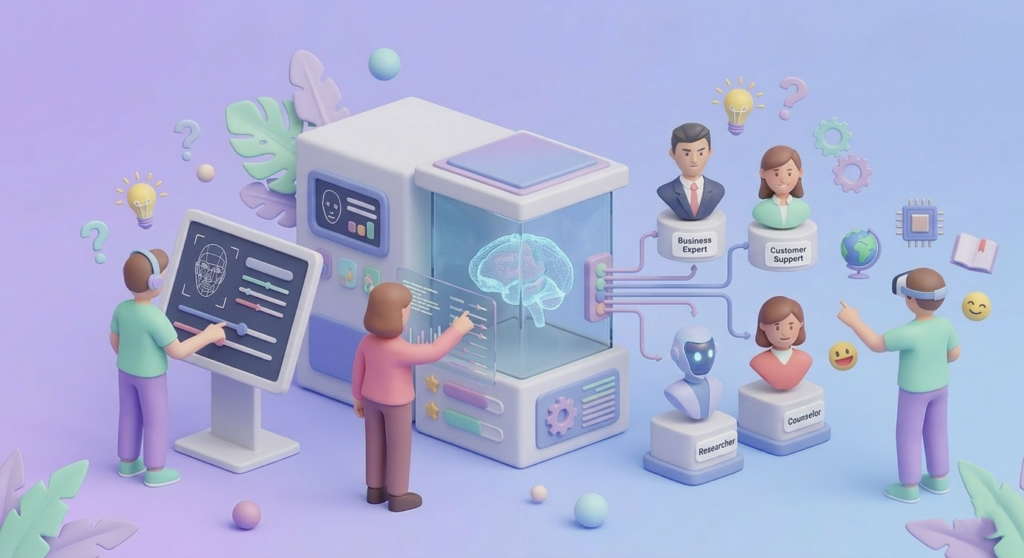
An AI persona is a digitally constructed character, built with a defined personality, background, communication style, emotional range, and behavioural patterns, that can engage in realistic, dynamic conversation with a learner.
Not a scripted chatbot. Not a decision tree that routes learners through predetermined responses. A genuinely responsive character that reacts to what the learner actually says, adapts to how they approach the conversation, and behaves with the kind of unpredictability that real human interaction involves.
Approach a persona poorly and they become guarded. Demonstrate genuine empathy and they open up. Push too hard and they shut down. The feedback isn’t delayed; it’s immediate, embedded in the conversation itself, experienced rather than explained.
This is the shift that changes everything. The learner is not reading about how to handle a difficult conversation. They are having one.
The AI Persona Generator: Building Characters for Your Context
Here’s where it gets practical.
The most powerful thing about modern AI persona technology is not the personas themselves; it’s the ability to build exactly the right persona for your specific training context.
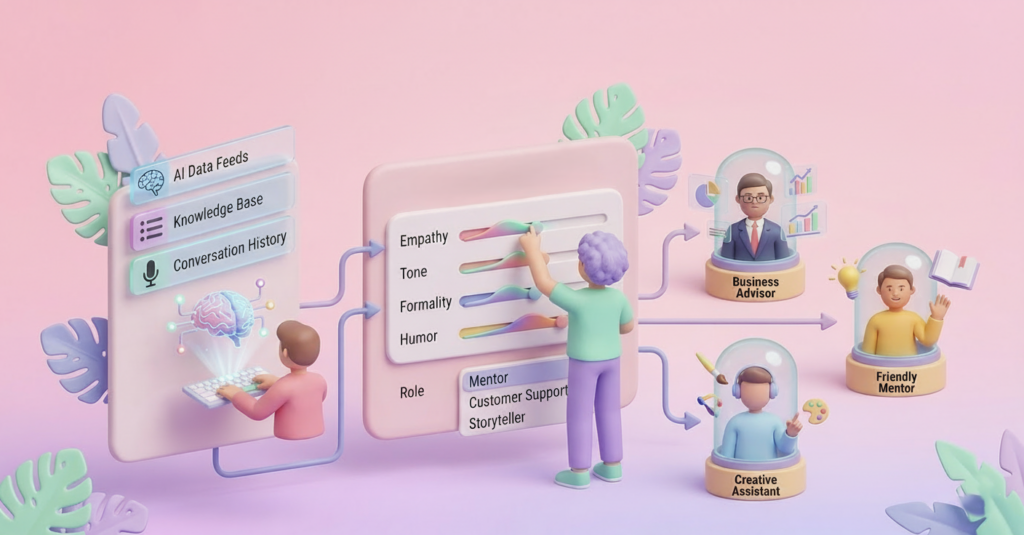
An AI persona generator allows training organisations to create custom characters tailored to their sector, their learner cohort, and their specific learning objectives. Without technical expertise. Without developers. Without months of lead time.
A mental health training program can build a persona representing a young person experiencing their first episode of psychosis. A corrections program can build a persona representing a detainee with a long history of institutional distrust. A healthcare program can build a persona representing a family member in acute distress following a diagnosis.
Platforms like SethCo AI provide guided persona builder tools that walk training professionals through character development, defining psychological frameworks, communication patterns, emotional triggers, and responses to different learner approaches. The result is a character that behaves consistently across every interaction while remaining dynamically responsive to each individual conversation.
This level of specificity is what separates meaningful simulation from generic roleplay. The more closely a practice scenario reflects the real situations learners will face, the more effectively it prepares them to face those situations.
Who AI Persona Technology is For?
AI persona technology is not a solution looking for a problem. It is a direct response to the training challenges that high-stakes sectors have been working around for years.
In mental health and crisis services, practitioners need to be equipped for sensitive disclosures, risk assessment conversations, and managing acute distress, often with very little notice and under significant emotional pressure. AI personas allow crisis workers and counsellors to rehearse these conversations repeatedly before they encounter them in practice, building both competence and composure.
In corrections and justice, the ability to build rapport with resistant individuals, recognise escalation patterns, and respond to hostility without inflaming a situation is critical. These are capabilities that develop through experience. AI personas make it possible to accumulate that experience safely, before it counts.
In youth protection and community services, workers regularly encounter young people in crisis, families under stress, and situations that require careful navigation of professional boundaries. The emotional complexity of these interactions demands practiced skill, not just theoretical knowledge.
In healthcare and residential care, staff face patient aggression, ethical dilemmas, and distressed family members as a routine part of their role. Simulation training with realistic AI personas prepares them for these moments in a way that a classroom session simply cannot.
The common thread across all of these sectors? The learners who perform best under pressure are those who have practiced under pressure. AI persona technology makes that practice accessible, scalable, and available on demand.
What About the Human Elements?
This is worth addressing directly, because it comes up every time.
AI personas do not replace human facilitators. They do not replace clinical supervision, mentorship, or the nuanced debriefing that an experienced practitioner can provide after a difficult scenario. Those things matter, and they will continue to matter.
What AI personas replace is the part of the process that was never working well to begin with: the expensive, logistically complicated, inconsistent, fatigue-limited roleplay component that most programs either underfund or skip entirely.
Think of it this way. A surgeon doesn’t become skilled by reading about surgery and then operating on a real patient. They practice. Extensively. In conditions designed to be as realistic as possible without the full consequences of a real procedure. The simulation is not a replacement for the operating theatre; it’s what makes the operating theatre safer for everyone.
Why would we expect professionals in community services, corrections, or mental health to develop interpersonal skills any differently?
The strongest training programs use AI personas to extend practice opportunities, not replace the human elements that genuinely matter. A learner who has had twenty realistic conversations with a well-designed AI persona before sitting down with a clinical supervisor for debriefing is going to get far more out of that conversation than one who arrives having only read about the concepts. The human element becomes richer when the groundwork has already been laid.
This is the model worth building toward: not AI instead of human expertise, but AI handling the volume and repetition so that human expertise can be focused where it counts most.
Measuring What Actually Matters
Here’s another uncomfortable truth: most training programs measure the wrong things.
Completion rates. Quiz scores. Time spent on platform. These metrics are easy to capture and largely meaningless as indicators of actual capability development. They tell you whether a learner showed up. They tell you very little about whether that learner is prepared for the situations they will face.
AI persona interactions generate a different kind of data. Because every conversation is captured, trainers can review how learners approach difficult scenarios, identify patterns across cohorts, and deliver targeted coaching based on actual performance, not self-reported confidence or recall of theory.
Did the learner escalate the situation when they should have de-escalated? Did they miss a critical cue that the persona was becoming distressed? Did they default to the same ineffective approach across multiple attempts without adjusting their strategy? These are the insights that matter, and they only emerge when you can observe learners in realistic practice, not when you review their quiz results.
This shifts assessment from a summative event at the end of a program to a continuous process embedded within practice itself. The OECD’s work on competency-based approaches to professional development supports what experienced L&D professionals already know: that ongoing, performance-based assessment produces more accurate and actionable data about learner development than traditional testing alone.
For training managers who need to demonstrate return on investment, this matters. It means being able to show not just that learners completed a program, but that their capability measurably improved as a result. It means identifying who needs additional support before they enter the field, not after an incident reveals a gap in their preparation.
The National Institutes of Health research on simulation-based learning reinforces this further: skills developed through realistic practice transfer more reliably to real-world performance than those acquired through instruction alone. That’s not a surprising finding. But it is a finding that most training program designs continue to ignore.
Readiness Is the Standard
Most training programs set the bar at completion. Learners finish, a record is updated, and the program is considered done. But finishing a course and being prepared for what the job actually demands are two very different things, and in high-stakes professions, that distinction has real consequences.
The learners who struggle in their first difficult situation on the job are rarely the ones who didn’t pay attention during training. They’re the ones who never had the opportunity to practice before it mattered. They encountered the theory, understood it well enough to pass an assessment, and then met the real thing completely unprepared for how it would feel.
That’s not a learner problem. That’s a design problem.
AI persona technology exists precisely to close that gap, to give learners the kind of repeated, realistic practice that builds genuine capability rather than just documented completion. The tools are accessible, the evidence is clear, and the professions that need this most are the ones that have been working around the limitations of traditional training for years.
The question worth asking of any training program is a simple one: if your learners walked into their hardest day on the job tomorrow, would your training have prepared them for it?
If the answer is uncertain, it might be time to rethink what you’re designing for.
