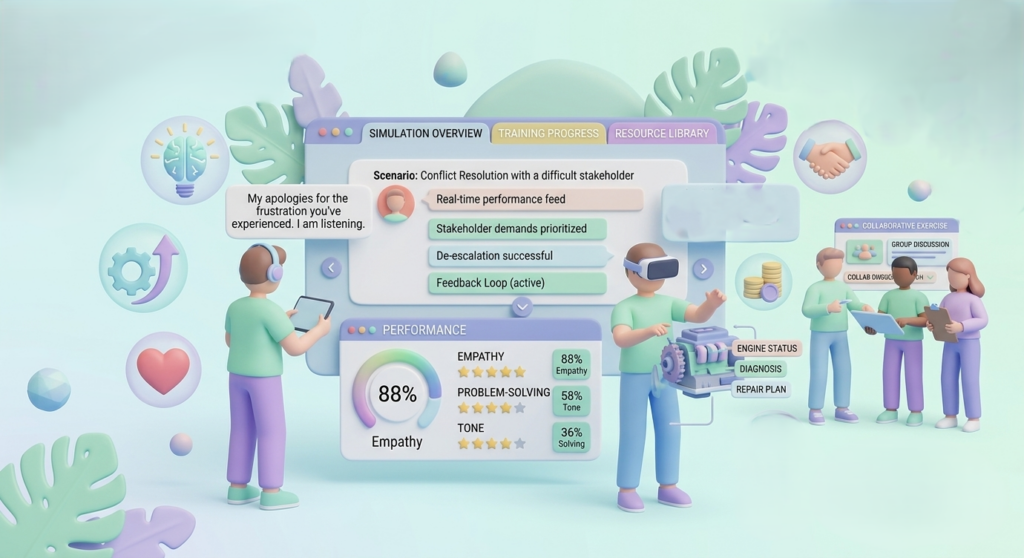
Moving learning into the digital space is not about uploading workbooks into a learning management system. And it is not about recording a lecture and calling it online education. It is about recognising that the shift to digital is an opportunity, one that most training programs are still leaving on the table.
Nowhere is this more important than in industries where the stakes are high and the conversations are hard.
For training managers and educators working across community services, healthcare, corrections, mental health, and customer-facing roles, the question is not whether to use technology. The question is how to use it in a way that genuinely builds capability rather than simply delivering content.
This is where simulation training changes the conversation.
The Problem with Content-First Training Design
Many online training programs still follow a familiar and comfortable pattern. Content is uploaded. Learners read, watch, and complete a quiz. A completion certificate is generated. A box is ticked.
But content consumption is not the same as skill development. Knowing what to do in a crisis and being able to do it under pressure are entirely different things. For professionals who will work with people in distress, manage volatile situations, or navigate sensitive disclosures, passive learning is not enough preparation.
Research consistently supports this gap. According to the Learning and Work Institute, learners retain significantly more when they are actively engaged in applying knowledge rather than simply receiving it. The shift from passive to active learning is not a pedagogical preference; it is a practical necessity for professions where the cost of unpreparedness is real.
The best training experiences share a common quality. They feel purposeful. They mirror real tasks. They place the learner inside the situation rather than outside it, observing from a distance. This is where thoughtful learning experience design becomes the differentiator between training that ticks a box and training that actually builds capability.
That shift, from consumption to immersion, is what simulation training makes possible.
What Simulation Training Actually Means
Simulation training is not a new concept. Flight simulators, surgical training environments, and crisis response drills have long recognised that competence is built through practice in realistic conditions, not through reading about them.
What has changed is accessibility. Digital simulation training now allows organisations to create realistic, repeatable practice environments without the logistical complexity of coordinating actors, booking rooms, or managing scheduling conflicts.
At its core, simulation training places learners in scenarios that closely mirror the situations they will encounter in their roles. They make decisions. They respond in real time. They experience the consequences of their choices within a safe environment where mistakes carry no real-world cost.
This approach is particularly powerful for developing interpersonal skills: communication under pressure, de-escalation, empathetic listening, professional boundary-setting. These are the kinds of capabilities that are difficult to assess through a written task and impossible to build through passive reading.
The National Training Authority’s research on experiential learning reinforces what practitioners already know intuitively: skills developed through practice in realistic contexts transfer more reliably to the workplace than those acquired through instruction alone.
Traditional Roleplay vs Simulation Training
Traditional roleplay has always been one of the more effective tools in a trainer’s kit. Placing learners in simulated conversations with a colleague or actor creates a level of realism that no written task can replicate. But it comes with significant limitations that are rarely acknowledged honestly.
Availability is the first constraint. Meaningful roleplay requires a skilled facilitator or actor who can respond authentically, stay in character under pressure, and adapt to the unpredictable directions a learner might take the conversation. These people are not always available, and when they are, their time is expensive.
Consistency is the second. The quality of a roleplay experience depends heavily on who is playing the other role. A tired facilitator at the end of a long training day delivers a different experience than the same facilitator at their best. Learners trained in different cohorts may encounter vastly different versions of the same scenario.
Repetition is the third and perhaps most significant limitation. Real skill development requires practice, not once, but many times, across varying conditions. Traditional roleplay cannot scale to meet that need. Scheduling a single session is a logistical challenge. Scheduling ten is rarely realistic.
Simulation training addresses each of these constraints directly. Scenarios are available on demand. Characters behave consistently regardless of the time of day or the size of the cohort. And learners can repeat challenging interactions as many times as they need to, without fatigue, without scheduling friction, and without the social anxiety that can make live roleplay feel more like a performance than a practice.
This does not mean traditional roleplay has no place. Human facilitators bring nuance, emotional intelligence, and the ability to debrief in ways that technology cannot fully replicate. The strongest training programs use simulation to extend practice opportunities, not replace the human elements that matter most.
Designing Simulation Training That Reflects Real Work
Effective simulation training does not begin with technology. It begins with a clear understanding of the role.
What situations will this person actually face? What does a difficult conversation look like in this context? What decisions need to be made, and what does getting it wrong look like in the real world?
Once the role is understood, the training designer can begin mapping scenarios to the specific capabilities that need to be developed. This might include:
- A community services worker supporting a client experiencing a mental health crisis
- A corrections officer managing a confrontational interaction with a detainee
- A healthcare professional navigating a distressed family member
- A customer service team member handling an escalating complaint
The scenario becomes the vehicle. The skill is what is being developed. The simulation is what makes practice possible before the real moment arrives.
The Role of AI Personas in Modern Simulation Training
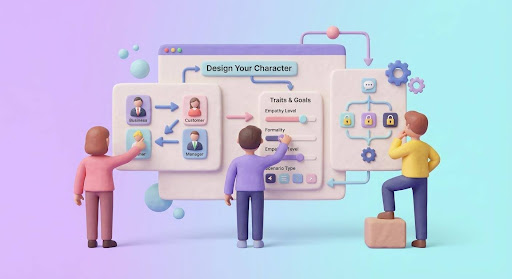
One of the most significant developments in simulation training is the emergence of AI personas: characters built with psychological depth, consistent personality traits, and the ability to respond dynamically to learner input.
Unlike scripted role plays, AI personas do not follow a fixed path. They react to what the learner says and how they say it. They can express frustration, shut down, become more open, or escalate, depending on the approach taken. This creates a training experience that is both realistic and unpredictable in the ways that real human interaction is unpredictable.
Platforms like SethCo AI allow training organisations to build custom AI personas calibrated to their specific learning objectives. A persona might represent a client with a trauma history, a patient in acute distress, or a young person in crisis. The character remains consistent across every learner interaction while responding naturally to each individual conversation.
This means every learner trains against the same baseline, but no two conversations are identical. The American Psychological Association’s research on deliberate practice highlights that this kind of structured, repetitive engagement with realistic challenges is one of the most reliable pathways to genuine expertise.
Simulation Training Across the Workforce
The value of simulation training extends well beyond traditional vocational education. Across sectors, organisations are recognising that the most critical professional skills are those that cannot be developed in a classroom alone.
In healthcare and residential care, staff need to be prepared for patient aggression, family conflict, and ethically complex decisions. Simulation training allows clinical and support staff to rehearse these situations before they encounter them in practice. The Australian Commission on Safety and Quality in Health Care has consistently advocated for simulation-based approaches in clinical training for this reason.
In corrections and justice, the ability to de-escalate a volatile situation or build trust with a resistant individual can have serious consequences if underdeveloped. Simulation environments allow officers and support staff to practice these interactions repeatedly, safely, and without fatigue.
In mental health and crisis services, counsellors and crisis workers need to be equipped for sensitive disclosures, suicide risk assessment, and managing acute distress. The stakes make practice essential, but traditional roleplay training creates its own barriers: cost, availability, and the emotional burden placed on human actors.
In customer-facing industries, frontline teams need to maintain professionalism and empathy under pressure. Simulation training allows them to develop those skills before they are tested in front of a real customer.
Measuring the Outcomes of Simulation Training
One of the persistent challenges in training design is demonstrating that learning has actually occurred, not just that learners completed a program, but that their capability genuinely improved as a result.
Simulation training creates natural measurement opportunities that passive learning cannot.
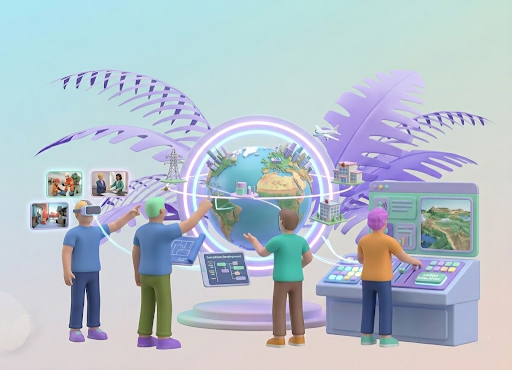
Because learners interact with scenarios in real time, their responses can be captured, reviewed, and assessed against defined competency frameworks. Trainers can observe how a learner approaches a difficult conversation, identify patterns across a cohort, and deliver targeted coaching based on actual performance data rather than self-reported confidence.
This shifts assessment from a summative event at the end of a program to a continuous process embedded within practice itself. The OECD’s work on competency-based education supports this approach, noting that ongoing, performance-based assessment produces more accurate and actionable data about learner development than traditional testing alone.
For training managers, this has practical implications. It means being able to demonstrate return on investment not just through completion rates, but through measurable improvements in the specific skills the training was designed to develop. It means identifying which learners need additional support before they enter the field, rather than after an incident has occurred.
The data generated through simulation training also supports program refinement over time. If a particular scenario consistently reveals a gap in learner capability, that is valuable intelligence for improving both the training design and the broader onboarding process.
Moving Beyond the LMS
The learning management system remains a useful tool for structure, navigation, and record keeping. But it was never designed to be the only environment where learning occurs.
Simulation training does not replace the LMS. It extends what is possible within a training program. It fills the gap between knowledge acquisition and real-world application, the gap where most traditional training falls short.
The goal is not to abandon existing infrastructure. It is to rethink how learning is designed within and around it.
When training is designed around real scenarios, real decisions, and real consequences, even in a simulated environment, learners arrive at their roles with something more valuable than knowledge. They arrive with experience.
A Practical Starting Point
If you are considering how simulation training might work within your programs, start with the role, not the technology.
Identify one situation your learners will face that genuinely requires practiced skill rather than recalled knowledge. Map the capabilities that situation demands. Then ask whether your current training approach gives learners any opportunity to practice those capabilities before the real moment arrives.
If the answer is no, or not enough, simulation training is worth exploring.