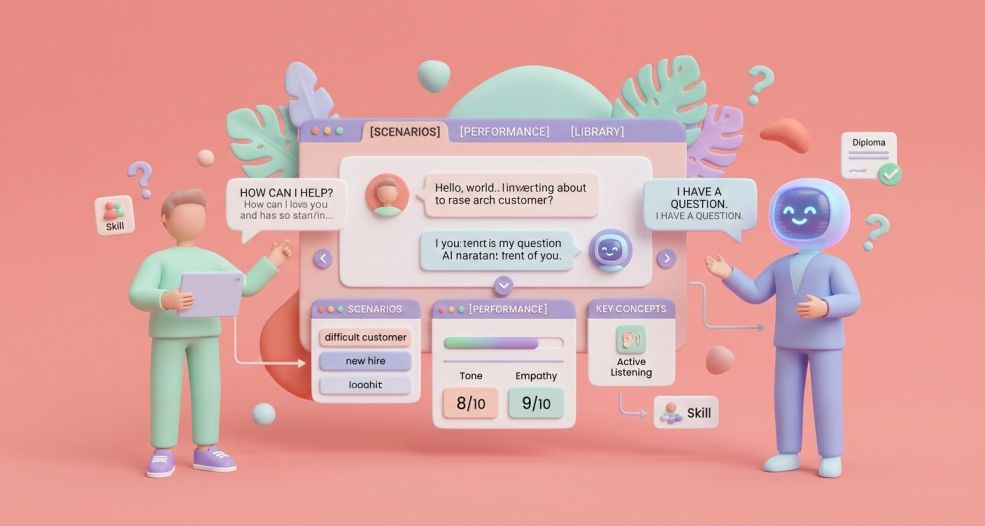
Ask any experienced trainer what separates a learner who is genuinely work-ready from one who just scraped through their assessment, and the answer is usually the same.
Practice.
Not practice in the abstract, reading scenarios, answering questions about what they would do, discussing cases in theory. Actual practice. The kind where they have to say something, respond to something unexpected, and feel what it is like when the conversation goes in a direction they did not anticipate.
This is what role play training has always tried to deliver. And for good reason, because when it works, it works in a way that almost nothing else in a training program can replicate.
The problem is that making it work consistently is harder than most training programs acknowledge. And the gap between role play training done well and role play training done poorly is wide enough to render the whole exercise pointless.
This article looks at what makes role play training effective, where traditional approaches fall short, and how AI roleplay training is beginning to change what is possible for VET trainers, L&D professionals, and anyone designing programs for high-stakes interpersonal work.
Why Role Play Training Works
There is a reason role play training has been a fixture of professional development for decades. It is not tradition for tradition’s sake. It works because of something fundamental about how human beings actually develop skill.
Reading about a difficult conversation is a cognitive exercise. Having one, even a simulated one, is an entirely different experience. The moment a learner has to respond in real time, without a script, to someone who is upset, resistant or distressed, something shifts. They are no longer processing information. They are applying it, under pressure, with immediate consequences for how well they apply it.
This is what makes role play training uniquely valuable for professions built around interpersonal communication, community services, healthcare, corrections, mental health, customer-facing roles, and youth work. In these fields, the core skill is not knowing what to do. It is being able to do it when the situation is uncomfortable, unpredictable, and emotionally charged.
Role play training creates a rehearsal space for exactly those moments. Learners can encounter challenging scenarios before the real thing arrives. They can make mistakes without real-world consequences. They can try a different approach, feel what works, and build the kind of muscle memory that reading about best practice simply cannot develop.
The Association for Talent Development consistently identifies experiential learning approaches, of which role play is one of the most accessible, as among the most effective methods for developing interpersonal and communication skills in professional contexts. The evidence has been consistent for years. Experience builds capability in ways that instruction alone cannot. This is precisely the principle that underpins learning experience design: the idea that what learners do during training matters far more than what they are told.
Role Play, Case Studies, and Scenarios: Getting the Distinctions Right
Before getting into how to design effective role play training, it is worth clarifying some terminology that gets used interchangeably but means different things.
A scenario is the foundation. It is an outline of a situation; the context, the characters, the problem that needs to be resolved. A scenario describes the situation. It sets the stage but does not dictate how the learning happens.
A case study uses a scenario for analysis. The learner examines the situation from outside it reviewing what happened, considering what decisions were made, evaluating what could have been done differently. Case studies develop analytical thinking and contextual understanding. They are valuable tools, but they are not role play training. The learner is an observer, not a participant.
A role play uses a scenario for immersion. The learner is inside the situation, responding in real time, making decisions as they unfold. They are not analysing what someone else did. They are doing it themselves, experiencing the pressure and complexity firsthand.
Understanding this distinction matters for training design. Case studies and role plays are not interchangeable. If you need learners to demonstrate communication skills, decision making under pressure, or behavioural responses to complex situations a case study will not give you that evidence. Only role play training will.
Where Traditional Role Play Training Falls Short
If role play training is so effective, why do so many programs deliver so little of it or deliver it so poorly?
The honest answer is that traditional role play training is logistically difficult to do well at scale.
The consistency problem. The quality of a role play experience depends heavily on who is playing the other role. A skilled facilitator who can stay in character, respond authentically, and adapt naturally to wherever the learner takes the conversation creates a completely different experience than a colleague who feels awkward, breaks character, or steers the scenario in an unrealistic direction. Most programs cannot guarantee consistency across cohorts.
The availability problem. Meaningful role play training requires a facilitator or actor whose time is genuinely scarce. Coordinating schedules, booking rooms, and managing the logistics of live role play sessions is time-consuming and expensive. Many programs run one or two sessions and consider the box ticked which is rarely enough for genuine skill development.
The repetition problem. Real competence requires repeated practice across varied conditions. A learner who has had two role play experiences is not meaningfully more prepared than one who has had none. But scheduling ten sessions per learner is not realistic for most organisations. So the practice that actually builds skill never happens at the volume needed.
The anxiety problem. For many learners, role play training in front of peers or assessors triggers performance anxiety that interferes with learning. They are managing their discomfort rather than practicing the skill. The social pressure of being observed changes the experience in ways that can undermine its value.
These are not small problems. They are structural limitations of traditional role play training that most programs work around rather than solve.

What Effective Role Play Training Actually Requires
Before exploring what AI roleplay training makes possible, it is worth being clear about what good role play training looks like regardless of the method.
Effective role play training needs realistic scenarios that genuinely reflect the situations learners will face. Generic or obviously artificial scenarios reduce engagement and transfer poorly to real work. The closer the scenario mirrors the actual workplace, the more valuable the practice.
It needs characters or facilitators who respond authentically who can push back, express genuine emotion, and adapt naturally to what the learner does. A character who follows a script regardless of how the learner responds teaches nothing about real human interaction.
It needs the ability to repeat. Skill development does not happen in a single session. Learners need to practice the same type of scenario multiple times, ideally across varying conditions, until the response becomes natural rather than effortful.
It needs feedback that is specific and timely. Telling a learner they did well after a session is not feedback. Identifying the specific moment where their approach shifted the conversation, and explaining why, is feedback. The closer that feedback is to the moment it applies to, the more effectively it supports learning.
And it needs to feel safe enough that learners are genuinely practicing rather than performing. Anxiety about being judged undermines the whole exercise.
AI Roleplay Training: What It Changes
AI roleplay training does not replace the principles above. It makes them achievable at scale in a way that traditional methods cannot.
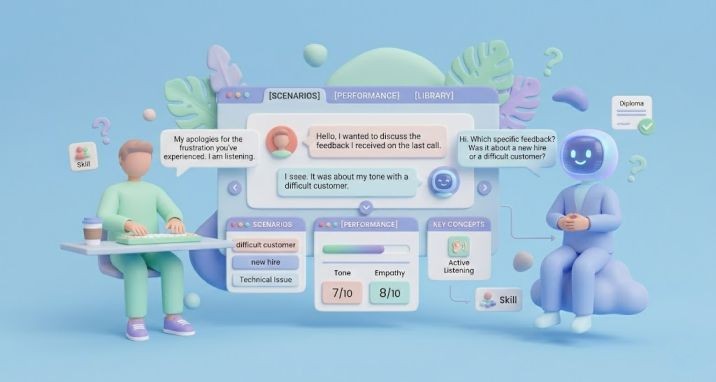
The core of AI roleplay training is the AI persona, a digitally constructed character with a defined personality, psychological background, communication style, and emotional range, capable of responding dynamically to whatever the learner says. Not a scripted chatbot that routes conversation through predetermined paths. A genuinely responsive character whose behaviour shifts based on how the learner engages and the psychology behind how these characters are built is more deliberate than most people realise.
Approach the character with empathy and they open up. Push too hard and they become defensive. Miss a critical cue and the conversation deteriorates in exactly the way a real conversation would. The learner is not reading about these dynamics, they are experiencing them, in real time, with immediate feedback embedded in the character’s response.
This solves the consistency problem; every learner trains against the same character baseline regardless of cohort or timing. It solves the availability problem. AI roleplay training is available on demand, at any hour, without scheduling. It solves the repetition problem; learners can practice the same scenario as many times as they need to, without fatigue, without cost increases, without logistics. And it solves the anxiety problem. Practising privately with an AI character removes the social pressure that makes traditional role-play training uncomfortable for many learners. For a deeper look at how simulation-based approaches work in practice, this piece on simulation training covers the broader design principles in detail.
Platforms like SethCo AI allow training organisations to build custom AI personas calibrated to their specific learning objectives and sector contexts. A VET trainer delivering community services qualifications can build a persona that reflects the exact client profiles their learners will encounter. An L&D professional designing onboarding for a mental health organisation can create characters with the specific trauma histories, communication patterns, and emotional triggers relevant to that workplace.
The result is role play training that is not only more accessible and scalable than traditional methods, it is more precisely targeted to the situations that actually matter.
Designing Role Play Training That Works, With or Without AI
Whether you are designing traditional role play assessment for a VET qualification or building AI roleplay training scenarios for a professional development program, the design principles are the same.
Start with the situation, not the skill. What specific moment will your learner face in their role? What does it look like when it goes wrong? Design the scenario around that moment rather than around an abstract competency description.
Build in genuine complexity. Real workplace conversations are not linear. Characters should have competing needs, emotional undercurrents, and the capacity to surprise. A scenario that plays out the same way every time is not preparing learners for the unpredictability of real interaction.
Align to your assessment criteria, but do not let criteria drive the scenario design. The scenario should feel real first. Assessment alignment should follow from that, not the other way around.
Plan for debriefing. The conversation after the role play is where much of the learning is consolidated. Whether that debrief is facilitated by a human trainer reviewing an AI roleplay training session transcript or conducted live after a traditional role play, it needs to be specific, reflective, and forward-looking.
The Direction This Is Heading
Role play training has always been valuable. The limitations have never been about the method itself, they have been about the practical constraints that made it difficult to deliver at the quality and volume needed to actually develop competence.
AI roleplay training removes most of those constraints. It does not change what good role play training looks like. It changes who can access it, how often, and how consistently.
For VET trainers designing assessment instruments, that means new tools for delivering the kind of realistic, repeatable practice that competency-based assessment has always called for. For L&D professionals building programs for high-stakes professions, it means finally being able to close the gap between what training programs promise and what they actually deliver.
